Your LinkedIn profile is working right now. The question is: what is it working to do?
For most founders, the honest answer is that it is working to confirm what they already know about themselves. It lists their experience. It summarises their journey. It tells the story of how they got to where they are. And it completely fails to answer the only question that matters to a buyer landing on that page: is this the person who can solve my specific problem?
I reviewed my own profile against this standard in 2024. What I found was a biography. Well-written, accurate, and utterly useless for client acquisition. I rebuilt it using the 12-point CRICKETS checklist you are about to read. Within 60 days, the profile visits from the right buyers began. Within 90 days, the inbound started.
This checklist is built on the CRICKETS framework and scored across the same dimensions as the free LinkedIn Profile Audit tool. The 12 points are grouped into three tiers by impact: the four Critical changes that matter most to your buyer conversion, the four Important changes that determine your search visibility, and the four Foundation changes that complete the picture. If you want a broader read on your LinkedIn positioning before you start, run the free LinkedIn Positioning Health Check first.
◆ CRICKETS Profile Audit Scoring · 100 Points Total
The 12-Point LinkedIn Profile Optimisation Checklist
Rewrite Your Headline for Your Buyer, Not Your Title
Your LinkedIn headline is the most visible line on your profile. It appears in search results, on every comment you leave, on connection requests, and in the notifications of everyone who views your content. It is doing constant work. The question is whether it is doing the right work.
Most founder headlines say the job title and company name. This tells the platform who you are. It does nothing for the buyer who needs to know what you do for them specifically.
The correct structure for a founder headline is: the outcome you deliver plus the specific type of client you deliver it for. Optionally add a credibility signal or a market specifier. Keep it under 220 characters. Every word either converts or wastes an impression.
Before vs After
Founder and CEO at Acme Co | SaaS | Growth
I help B2B SaaS founders reduce churn by 30% in 90 days | Author of the CRICKETS Growth Playbook
◆ Live Example · Jennifer Omaliko's LinkedIn Profile
Here is how this plays out in practice. Jennifer's headline reads: LinkedIn Ghostwriter & Content Strategist for Startup Founders | 873% Impression Growth | I Turn Founders Into the Name Their Industry Keeps Mentioning. Buyer-facing. Proof-anchored. Outcome-led. No job title. No company name. The result: 6,000+ followers built organically with zero paid ads.
.jpg)
Rewrite Your About Section in Three Parts
The About section is the longest-form real estate on your LinkedIn profile and the second-most read section after the headline. For most founders it is written entirely in the wrong direction.
A biography About section tells your story. A conversion About section tells your buyer's story and positions you as the resolution. The three-part CRICKETS About structure:
- Part 1: Buyer Pain. Open with the problem your ideal client is experiencing right now. Not a general industry problem. The specific, felt pain that makes them open LinkedIn at 11pm. Two to three sentences. Write it so the right person thinks: "this is describing me exactly."
- Part 2: Your Proof. Introduce yourself through your documented results, not your credentials. Numbers where you have them. Outcomes where you do not. Keep it factual and specific.
- Part 3: Your Invitation. Close with a direct, low-friction invitation to the next step. "If your LinkedIn is active but the pipeline is quiet, book a free 30-minute call and I will tell you exactly what is holding it back."
Update Your Banner to Communicate Positioning at a Glance
The LinkedIn banner is the first visual element a profile visitor sees. It loads before your headline. It occupies the most visual real estate on the page. And the majority of founders either leave it as the default blue gradient or upload a logo that communicates nothing to a buyer who has never heard of their company.
Your banner image should do one thing: communicate your positioning to a stranger in under three seconds. Not your brand colours. Not your tagline. Your positioning statement as a founder, rendered visually.
The most effective founder banners are simple. A clean dark or neutral background. One to two lines of text in large type that state your outcome and buyer type. Optionally your primary proof number. No stock photos. No busy graphics. If a profile visitor cannot read your positioning from your banner and headline in three seconds, you have already lost most of them.
Build a Four-Piece Featured Section with Intention
The Featured section sits directly below your About and is the first place a profile visitor goes when they want to learn more. Most founders leave it empty, fill it with random posts, or add their company website without context.
The four-piece Featured structure that converts profile visitors into leads:
- Position 1: Your free diagnostic tool or lead magnet. The first Featured item should offer the visitor immediate value. For Jennifer's profile, this is the CRICKETS Toolkit. For you, it could be a free audit, a calculator, a checklist, or a template.
- Position 2: Your strongest social proof. A screenshot of a client result, a testimonial, an analytics screenshot, or a case study link. Visible and immediately readable.
- Position 3: Your booking link or services page. A direct link to your Calendly or services page. Remove every step between interest and action.
- Position 4: Your best content piece. Your most-read article, your newsletter link, or your most-shared post. This signals that you produce consistent, substantive content.
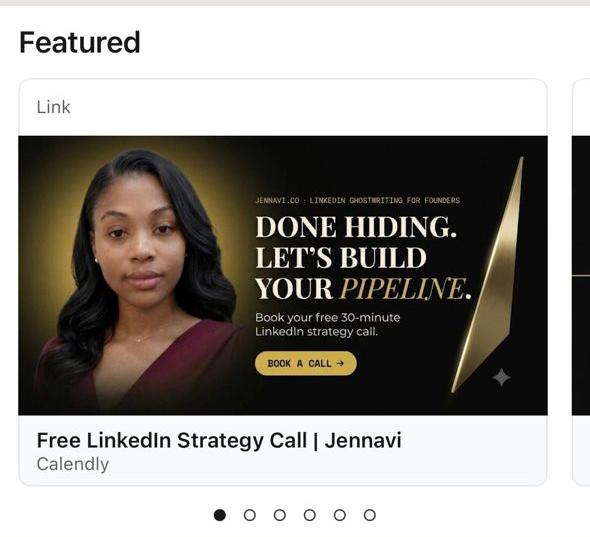
◆ Live Example · Jennifer Omaliko's LinkedIn Featured Section
This is Jennifer's Featured section in action. The Calendly strategy call link is embedded directly in position 3 -- no DMs, no back-and-forth, no friction. A founder who finds the profile, reads the About section, and is ready to take the next step can book a call in one click from the Featured section alone.
Rewrite Experience as Client Outcomes, Not Job Responsibilities
The Experience section is where most founders default to a resume format. Role title, company name, dates, and a list of responsibilities. This is the correct format for a job application. It is the wrong format for a buyer-facing profile.
Rewrite each Experience entry with one primary outcome first. What did you actually produce for clients, companies or markets in this role? Then two to three supporting points that add context. The format is: outcome first, evidence second, context third. Every line earns its place or it does not belong there.
Curate Your Skills for Search Visibility
The Skills section is one of LinkedIn's primary search ranking signals. When a buyer searches for "LinkedIn ghostwriter for founders" or "B2B content strategist," LinkedIn surfaces profiles partly based on the skills listed. Most founders either ignore this section or add skills in no particular order.
Curate your top three pinned skills deliberately. They should be the exact phrases your ideal buyer would type into LinkedIn search. Not your job title. The skill they are searching for. Ask your current or past clients what they would have searched before finding you. Those are your pinned skills.
Use a Profile Photo That Signals Authority
Profiles with professional photos receive significantly more profile views, connection requests and messages than those without. An authority-signalling profile photo for a founder has four qualities: it is recent, well-lit, your face occupies at least 60% of the frame, and the background is clean and undistracting.
You do not need a professional photographer. A recent phone photo in good natural light with a clean background outperforms an outdated studio headshot. What matters is clarity, recency and professionalism. Not perfection.
Activate Creator Mode
LinkedIn Creator Mode changes how your profile is displayed and how it interacts with the algorithm. For founders using LinkedIn as a content and positioning platform, it is a non-negotiable activation.
When Creator Mode is on: your profile displays your content topics in the header area, the Connect button is replaced with a Follow button which is better for building a content audience, and it unlocks the LinkedIn newsletter feature and link in bio. Creator Mode also signals to the algorithm that you are a content creator and increases the reach of your posts to non-connections. Activate it under Profile Settings, then Visibility.
Set a Custom Profile URL
LinkedIn gives every profile a default URL containing a random string of numbers. A custom URL that includes your name is a clean, professional signal and makes your profile easier to find via Google search.
Set your custom URL to your full name with no numbers if available: linkedin.com/in/jennifer-omaliko. If taken, add a relevant descriptor. Keep it short and include your actual name, not a brand name. A custom URL also improves LinkedIn SEO. When someone searches your name in Google, a clean custom URL profile is far more likely to appear on page one than a numeric default URL.
Turn Off Open to Work
The Open to Work green banner communicates that you are available for employment, which is the opposite of the authority signal your profile needs to generate inbound from buyers who want to hire your company.
If you are a founder with Open to Work visible, buyers receive a mixed signal before reading a single word. It introduces doubt about your commitment to your company and your confidence in what you have built. Turn it off. Your LinkedIn profile should do one job consistently: make your ideal client want to hire your company. Open to Work actively conflicts with that job.
Request and Display Recommendations
Recommendations are the closest thing LinkedIn has to verified social proof. A well-written recommendation from a real client carries more weight than any self-authored claim on your profile.
Request recommendations from your three to five best clients or collaborators. Give them a brief prompt to make it easy. Tell them what outcome to focus on and what context to include. A recommendation that says "Jennifer helped me go from 200 followers to 6,000+ in eight months and I started getting inbound DMs from real buyers by month three" converts profile visitors more than "Jennifer is great to work with." Three specific recommendations outperform ten vague ones every time.
Complete Your Contact Information
The Contact Info section is where warm leads go when they are ready to reach out but not yet ready to send a cold DM. If your contact information is incomplete, you are creating friction at the exact moment a buyer is ready to act.
Complete at minimum: your primary email address, your website URL pointing to your services page or homepage, and your booking link. Optionally add your WhatsApp number if you serve markets where WhatsApp is primary. Review your contact info with one question: if a warm lead wanted to reach me right now from my LinkedIn profile, in how many clicks can they do that? The answer should be one or two. If it is more, something is missing.
After the checklist: what comes next
A fully optimised LinkedIn profile is the foundation of your pipeline. It is not the pipeline itself.
The profile optimisation you have just completed does three things. It ensures that the right buyer who lands on your profile immediately recognises you as relevant to their problem. It signals to the LinkedIn algorithm what your profile is about and who it should surface you to. And it converts the warm traffic that your content sends to your profile into actual inquiries rather than bounced visits.
What it cannot do on its own is generate that warm traffic. That is the job of your content strategy. Specifically, posting three to four times per week with buyer-facing content that reinforces your positioning consistently for sixty days or more. The profile and the content are two sides of the same system. Neither works at full capacity without the other.
For the complete system that shows you how to turn your optimised profile and your content into a consistent B2B pipeline, read LinkedIn for B2B Founders: How to Turn Your Profile Into a Pipeline in 2026. And for the lead generation mechanics specifically, How to Get Inbound Leads From LinkedIn Without Paid Ads covers the conversion layer in full.
When Jennifer optimises a founder's profile
Every Jennavi retainer begins with a complete profile rebuild against this 12-point checklist. Before Jennifer writes the first piece of content for a client, the profile is positioned correctly. There is no point sending content traffic to a profile that will not convert it.
The profile rebuild covers: headline rewrite, About section rewrite in the three-part CRICKETS structure, banner brief or redesign, Featured section strategy, Experience rewrite for outcome framing, Skills curation for market-specific search terms, Creator Mode activation, and contact information completion. For US, UK, Australian and Canadian founders specifically, the skills and headline keywords are calibrated for each market's search behaviour.
If you want Jennifer to do this for you and then maintain the content strategy that sends the right traffic to your newly optimised profile, the next step is a free 30-minute strategy call. Book it here. Jennifer reviews your current LinkedIn before the call. She arrives with specific observations. No pitch. Just an honest assessment of exactly what your profile is costing you and what it could be doing instead.
◆ The CRICKETS Toolkit · All Free · No Signup · Instant Results
LinkedIn profile optimisation by market: US, UK, Australia, and Canada
The 12-point checklist applies universally. But the way you execute each point shifts depending on your primary market. Buyers in different regions respond to different signals, search using different terms, and hold different expectations of what a credible founder profile looks like.
United States. US buyers move fast and are highly search-driven. Your headline and Skills section need to include the exact phrases your buyer types into LinkedIn search: "B2B SaaS growth", "revenue operations", "product-led growth", "Series A", "go-to-market". The Featured section should lead with your most concrete proof -- a metric, a case study link, or a diagnostic tool. US founders on LinkedIn are competing in the most crowded English-language market, which means positioning clarity in your headline is not optional. It is the difference between appearing in search and being invisible. See the LinkedIn Positioning Health Check to score your positioning clarity before you write a word of content.
United Kingdom. UK buyers are more relationship-led and more sceptical of aggressive positioning language. Superlatives and hard-sell framing in your headline or About section will cost you credibility. The three-part About section works particularly well in the UK market because it leads with the buyer's problem rather than the founder's credentials -- which aligns with how UK B2B buyers prefer to be approached. Recommendations carry significant weight in the UK. Prioritise checklist point 11.
Australia. Australian founders often underestimate LinkedIn as a B2B channel. The market is smaller but significantly less competitive at the profile level, which means a correctly optimised profile stands out faster. The Skills section in the Australian market should include Australian-specific search terms alongside global ones. "SaaS Australia", "Australian startup", "B2B lead generation Australia" all surface in local searches. Creator Mode activation is particularly high-leverage in Australia because fewer founders use it, meaning your content gets more surface area per post.
Canada. The Canadian B2B market sits between the US and UK in tone. Less aggressive than the US, more direct than the UK. Canadian founders often serve both Canadian and US buyers simultaneously, which means your headline and About section need to work for both markets at once. The safest approach is US-calibrated positioning language with proof points that translate across borders. The Featured section should link to work or results relevant to both markets where possible.
If you work with clients across more than one of these markets and want your profile to pull from all of them simultaneously, Jennavi's profile optimisation service handles the multi-market calibration as part of the profile rebuild.
The mistakes that cancel a LinkedIn profile optimisation
Most founders implement some of the 12 points and wonder why the results are partial. The checklist only works when every point is implemented correctly and simultaneously. These are the mistakes that most commonly cancel the work.
Keeping a title-based headline after implementing everything else. Your headline is the first line on every search result, every comment, every connection request. If it still says "Founder and CEO at [Company]" after you have rewritten everything else, your profile will not convert the traffic that your content sends to it. The headline is the single highest-leverage change in this checklist. It also takes the least time to implement. There is no reason to leave it as a title.
Writing the About section as a biography. The biography structure -- "I founded [company] in [year] after working at [previous company]" -- is written for the founder's ego, not the buyer's problem. The buyer who lands on your profile does not need your professional timeline. They need to feel, in the first two lines, that you understand their specific problem. If your About section does not open with your buyer's pain, it is working against every other change you have made.
Featured section that links to the company homepage. A link to your homepage tells the buyer nothing about what you can do for them specifically. The Featured section is prime real estate. It should link to your most valuable proof -- a case study, a diagnostic tool, a piece of content that demonstrates your methodology. The free Profile Audit scores your Featured section as one of its four dimensions precisely because it is where most founders waste their highest-traffic profile real estate.
Open to Work left on. If you are a founder running a company, Open to Work signals to every buyer who visits your profile that you are available for employment. It undermines every positioning signal in your headline and About section. Turn it off immediately. This is checklist point 10 and it takes thirty seconds.
Optimising the profile and then going quiet on content. A correctly optimised profile converts warm visitors. It does not generate them. If you complete this checklist and then stop posting, your impression count will not move. The profile and the content strategy are a system. For how to build the content side of that system, read LinkedIn for B2B Founders: How to Turn Your Profile Into a Pipeline in 2026.
How profile optimisation connects to your full LinkedIn system
The 12-point checklist is not a standalone exercise. It is the foundation layer of a three-part system that generates consistent B2B inbound from LinkedIn without paid ads.
Layer one is the profile -- which is what this checklist addresses. A correctly optimised profile ensures that every visitor who lands on your page immediately understands who you help, what outcome you deliver, and what the next step is. Without this layer, every other part of the system leaks. Content sends traffic to a profile that does not convert it. DMs go cold because the buyer's profile visit did not confirm the positioning your content promised.
Layer two is the content strategy -- posting buyer-facing content consistently, three to four times per week, for a minimum of sixty days. The content feeds the algorithm, builds familiarity with your target buyer, and drives the profile visits that your optimised profile converts. For the full content strategy framework, see LinkedIn Content Strategy for Founders.
Layer three is the conversion layer -- what happens when the right buyer lands on your profile, connects, or sends a DM. This is where your Featured section, your About section CTA, and your direct message approach all matter. For the mechanics of converting LinkedIn activity into actual pipeline, read How to Get Inbound Leads From LinkedIn Without Paid Ads.
All three layers are built on the CRICKETS framework. The CRICKETS positioning playbook at $9.99 gives you the full strategic foundation. The free tools at jennavi.co/linkedin-tools.html let you audit and score each layer independently.
Why most LinkedIn ghostwriters skip the profile and why that costs founders
The majority of LinkedIn ghostwriting services start with content. They onboard a client, ask for three bullet points about their work, and begin posting within the first week. The profile stays untouched. This is one of the most expensive mistakes in the LinkedIn ghostwriting industry.
Content without a correctly positioned profile is like running paid ads to a landing page with no headline. The traffic arrives and immediately bounces because nothing on the page confirms what the ad promised. On LinkedIn, the equivalent is a buyer seeing a compelling post, clicking through to the profile, and finding a title-based headline, a biography About section, and a Featured section linking to the company homepage. The content did its job. The profile cancelled it.
Jennavi does not start with content. Every client engagement begins with the 12-point profile rebuild against the CRICKETS checklist. The profile is positioned correctly before the first piece of content is written. This is why Jennavi clients see profile view increases and inbound inquiries within the first thirty days -- not because the content is better, but because the entire system is working as a single unit from day one.
If you want to understand why Jennavi works differently from other LinkedIn ghostwriting services, this page explains the methodology in full. If you are ready to start, book the free 30-minute strategy call. Jennifer reviews your current LinkedIn before the call. No pitch. Just an honest read of what your profile is doing and what it could be doing instead.
The LinkedIn profile audit score: what it measures and why it matters
The free LinkedIn Profile Audit tool scores your profile across four dimensions, each weighted to reflect its actual impact on buyer conversion and search visibility. Understanding the scoring logic helps you prioritise the 12-point checklist correctly.
Positioning clarity (40 points). This is the highest-weighted dimension because it is the most important. It covers your headline, your About section structure, and your banner. These are the three elements that a buyer reads in the first fifteen seconds of landing on your profile. If the positioning is unclear, the other 60 points are irrelevant. The buyer has already left.
Content signals (35 points). This dimension covers your Featured section, your Creator Mode activation, your posting frequency signal, and your topic consistency. It measures whether your profile signals to both the algorithm and the human visitor that you are an active, relevant content creator in your specific niche. A profile with strong positioning but weak content signals will convert visitors slowly because there is no social proof that you show up consistently.
Profile completeness (25 points). This dimension covers the technical completeness of your profile -- custom URL, contact information, Skills section, Experience section, recommendations, and profile photo quality. These elements do not individually drive conversion, but their absence signals incompleteness to both the LinkedIn algorithm and the buyer. A complete profile ranks higher in LinkedIn search results than an incomplete one, regardless of content quality.
Run the free audit at jennavi.co/linkedin-profile-audit.html to get your score across all three dimensions before and after implementing this checklist. The score gives you a baseline and lets you measure the exact impact of each change.
Profile Optimisation Questions Founders Ask Jennifer
Want Jennifer to Optimise Your Profile and Build Your Pipeline?
Book a free 30-minute strategy call. Jennifer reviews your LinkedIn before the call and arrives with specific, honest observations about your profile and what needs to change. No pitch. Just clarity. Then if it is a fit, she builds and runs the entire system for you.
Jennifer Mmesoma Omaliko · Founder of Jennavi · Author of CRICKETS · Kano, Nigeria